The most common signs of a failing pneumatic actuator are an audible air leak, slow or jerky movement, loss of force, drift under load, and visible rod damage or corrosion. Repair the unit when the damage is limited to worn seals and the rod and body are intact. Replace it when the rod is bent or scored, the body is damaged, or the same cylinder keeps failing because it is the wrong size for the job. Catching these symptoms early lets you schedule the work instead of stopping the line.
What Is a Pneumatic Actuator, and Why Does It Fail?
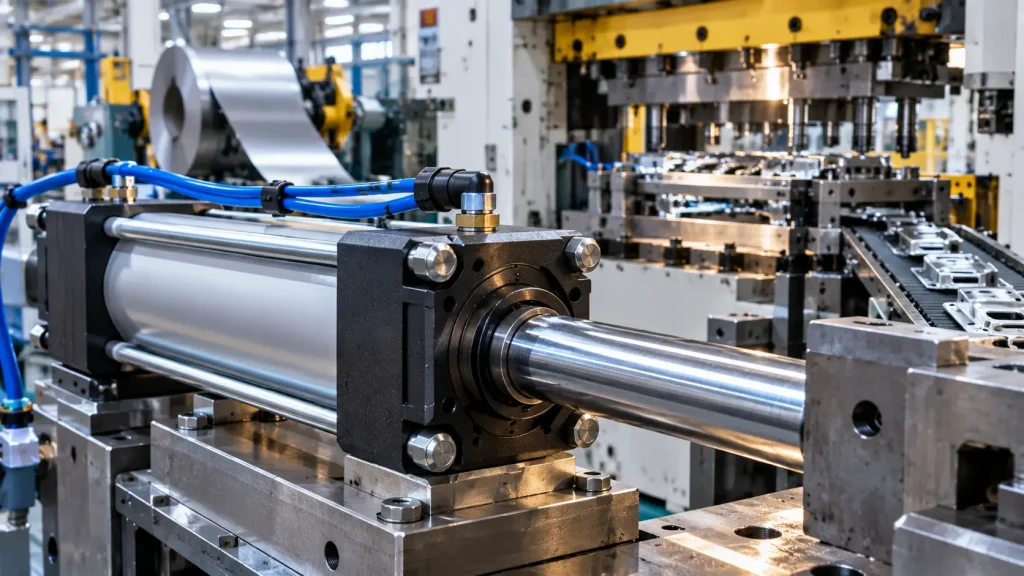
A pneumatic actuator is a device that converts compressed air into linear or rotary motion. In most plants this means a pneumatic cylinder: a piston moving inside a tube, driven by air pressure and connected to the load by a rod. The pneumatic cylinder comes in single-acting, double-acting, rodless, and other designs, but the failure patterns below apply to most of them.
Failures usually fall into two groups:
- Wear events: seals, bearings, or the rod surface wear out after long service. A cylinder that ran reliably for years and then began leaking is the typical case.
- Mismatch events: the cylinder is undersized, side-loaded, misaligned, or fed poor-quality air, so it fails repeatedly. New parts will not fix these.
Knowing which one you have changes the answer to the repair-or-replace question, so keep it in mind as you read the signs.
What Are the Signs of a Failing Pneumatic Actuator?
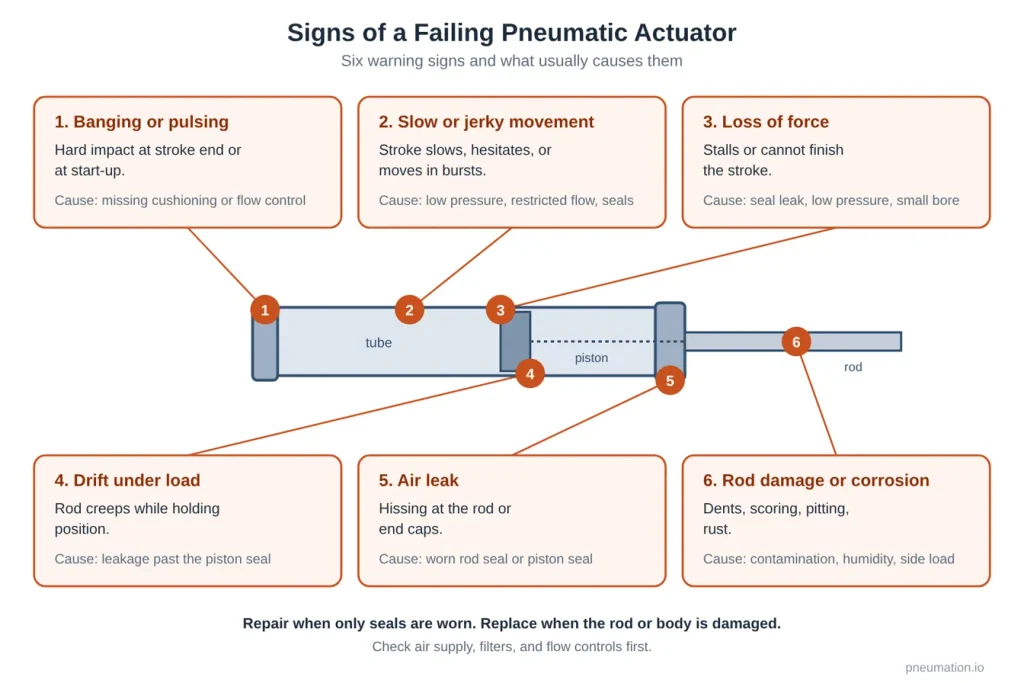
The main signs your pneumatic cylinder needs attention are listed below. Each one points to a likely cause, which is the starting point for pneumatic actuator troubleshooting.
| Sign | What You Notice | Likely Cause |
|---|---|---|
| Air leak | Hissing at the rod or end caps | Worn or damaged rod seal or piston seal |
| Slow or jerky movement | Stroke slows, hesitates, or moves in bursts | Low pressure, restricted flow, worn seals, misalignment |
| Loss of force | Cylinder stalls or cannot finish the stroke | Piston seal leak, low pressure, undersized bore |
| Drift | Rod creeps while holding position | Internal leakage past the piston seal |
| Banging or pulsing | Hard impact at stroke end or at start-up | Missing cushioning or flow control, abrupt start after shutdown |
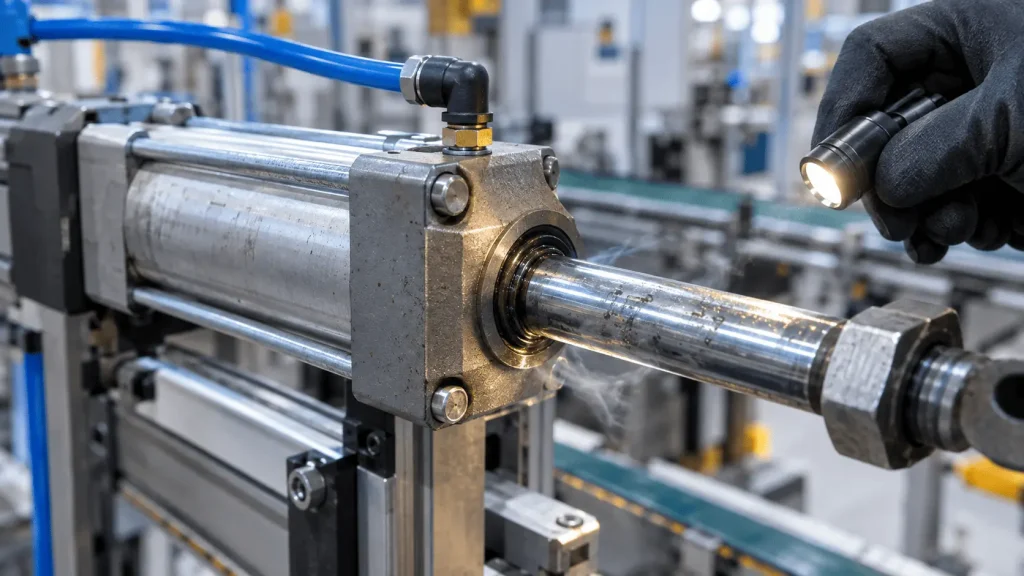
| Rod damage or corrosion | Dents, scoring, pitting, rust | Contamination, chemical or humidity exposure, side loading |
The sections below cover the four signs that most often decide whether a cylinder is repaired or replaced.
Is an Air Leak a Sign the Actuator Is Failing?
Yes. A hissing sound is one of the clearest warnings. An air leak at the rod usually means a worn or damaged rod seal, and a leak past the piston often means a worn piston seal. Either one wastes compressed air and reduces the force the cylinder can deliver.
Leak location matters. Valmet’s troubleshooting guide lists loose tie rods, pinched or extruded seals, and seal deterioration as causes of body leaks, and a torn or worn seal as a cause of rod-gland leaks. It also notes that soft-seal pistons should pass virtually no air, so excess flow at the end of the stroke points to a piston seal problem.
Why Is My Cylinder Moving Slowly or Jerkily?
Slow or jerky movement has more possible causes than any other symptom, so check the supply before blaming the cylinder. Low pressure, a misadjusted flow control, a plugged silencer, or a clogged filter can all slow the stroke. Valmet’s guide lists damaged seals among the same causes. Erratic movement can also come from misalignment between the cylinder and its load.
If the air supply and flow controls check out and the movement is still uneven, internal wear is the likely culprit. Flow controls such as PISCO speed controller push valves are worth checking first because they are inexpensive to adjust or swap.
What Does Loss of Force Mean?
Loss of force means the cylinder cannot push or pull what it used to. Common causes are a leaking piston seal, low supply pressure, or a bore that was never large enough for the load. The last case is a mismatch event: a cylinder that stalls or cannot complete its stroke from day one needs more force margin, not a repair.
What Rod and Body Damage Should You Look For?
Inspect the rod for dents, gouges, scoring, and pitting. Corrosion suggests exposure to chemicals, high temperature, or humidity and weakens the cylinder over time. Scoring inside the tube is often caused by particles, moisture, or corrosive substances in the air supply.
Pneumatic Cylinder Repair vs. Replace: How Do You Decide?
Repair when the failure is in seals or other wear parts and the structure is sound. Replace when the structure is damaged or the cylinder does not fit the job. The table summarizes the criteria described by industrial repair specialists such as IFP.
| Situation | Repair (Rebuild) | Replace |
|---|---|---|
| Rod condition | Straight and smooth | Bent or deeply scored |
| Tube and end caps | Structurally intact | Damaged tube, caps, or mounting features |
| Cause of failure | Normal wear of seals | Repeated failures, sizing or load mismatch |
| Parts | Seal kits available | Rebuild parts hard to source |
| Cost | Well below replacement | Approaching replacement cost |
| Lead time | Replacement unit has a long lead time | A new unit is available now |
One caution applies to both columns: new seals on a scored rod are only a short-term fix. If the cylinder has failed repeatedly on the same station, find the root cause before spending on another repair.
When Should You Replace a Pneumatic Cylinder?
Replace the cylinder when any of the following is true:
- The rod is bent or deeply scored.
- The tube, end caps, or mounting features are structurally damaged.
- The cylinder keeps stalling or failing to complete its stroke, which points to an undersized bore.
- Failures repeat even after fresh seals.
- You need a different specification, such as a stronger or faster unit.
When you do replace it, treat the moment as a chance to fix the cause. If the old unit was side-loaded, correct the alignment or add guidance. A guided cylinder can handle loads that would otherwise push on a standard rod, and a high-force unit can fix a chronic force shortfall. If you are unsure of the right type, our guide on how to choose a pneumatic actuator explains the options.
For like-for-like replacements, look at AirTAC standard NFPA cylinders, AirTAC compact cylinders, Fabco actuators, and Fabco high-force actuators. Check the mounting standard first, since NFPA and ISO cylinders do not interchange. Our comparison of NFPA vs. ISO cylinders covers the difference.
How Does Preventive Maintenance Extend Actuator Life?
Preventive maintenance is the cheapest way to avoid an unplanned failure, and most of it concerns air quality and installation. These practices reflect common manufacturer and industry maintenance guidance:
- Keep the air clean. Particulates, oil, and water can block moving parts and scar the tube. Change filters as the manufacturer specifies and review your air preparation systems. Air quality classes are defined in ISO 8573-1.
- Lubricate only as directed. Follow the manufacturer’s instructions. Without adequate lubrication, seals can dry out and fail, but lubrication should not be added where it is not needed.
- Prevent side loading. Force applied off the rod axis, usually from improper installation, causes uneven wear on the rod and bearing and can lead to seal failure and tube scoring.
- Inspect regularly. Look for cracks, corrosion, seal damage, and rust on fittings, and keep dust off the cylinder and bracket.
- Stock seal kits. Having repair kits on hand turns a long stop into a short one.
In high-cycle environments such as industrial manufacturing, a simple inspection routine is usually cheaper than the downtime from a single unplanned failure.
Frequently Asked Questions
Often an audible air leak or a slight slowdown in stroke speed. Both are early warnings that seals are wearing or that pressure or flow has dropped.
Yes, if the rod is straight and the tube and end caps are intact. Failures limited to worn seals can usually be fixed with a seal kit, provided the kit is available.
Check supply pressure, filters, flow controls, and silencers first. If those are normal and the symptom remains, the cylinder itself is likely worn.
Generally yes. A bent or deeply scored rod is a structural problem that new seals will not solve.
Supply clean, properly regulated air, avoid side loading, follow the manufacturer’s lubrication guidance, and inspect cylinders on a routine schedule.
Conclusion
A failing pneumatic actuator usually gives warnings before it stops: a hiss, a slower stroke, a drop in force, or visible rod damage. Check the air supply first, then decide by condition. Rebuild when seals are the problem and the structure is sound. Replace when the rod or body is damaged or the cylinder was never right for the load.
If you are replacing an actuator or want to prevent repeat failures, get in touch and we can help you match the right cylinder and air preparation to your application.