Choose a vacuum ejector for compact, fast, intermittent vacuum on machines that already have clean compressed air. Choose a vacuum pump for continuous or high-flow vacuum, or when electricity is cheaper than compressed air on your site. In the vacuum ejector vs vacuum pump decision, the deciding factors are duty cycle, required suction flow, and the real energy cost of each option, not the purchase price alone.
What Is the Difference Between a Vacuum Ejector and a Vacuum Pump?
A vacuum ejector creates vacuum with compressed air and has no moving parts, while a vacuum pump creates vacuum with an electric motor. An ejector, also called a Venturi vacuum generator, accelerates air through a nozzle to pull suction from a side port. If you want the full working principle, see our guide on what a vacuum generator is.
A vacuum pump removes gas from a sealed volume mechanically. Two broad types matter in automation. Positive-displacement pumps reach deeper vacuum at lower flow, while kinetic blowers deliver high flow at low vacuum.
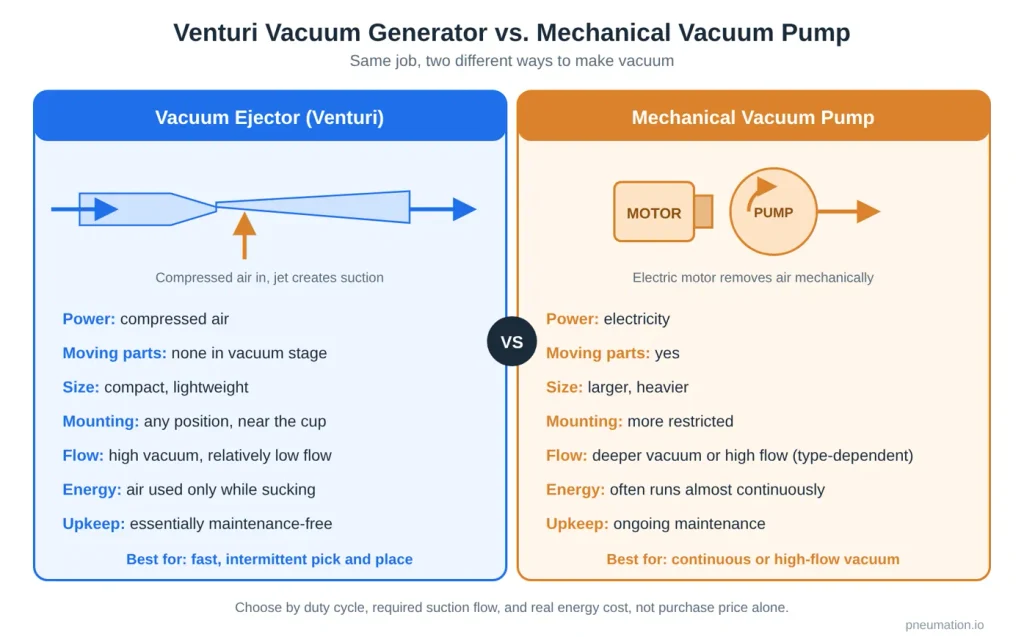
Venturi Vacuum Generator vs. Mechanical Vacuum Pump: Side-by-Side Comparison
The table below compares a Venturi vacuum generator with a mechanical vacuum pump across the factors that most often decide the choice.
| Factor | Vacuum Ejector (Venturi) | Mechanical Vacuum Pump |
|---|---|---|
| Power source | Compressed air | Electric motor |
| Moving parts | None in the vacuum stage | Yes |
| Size and weight | Compact, lightweight | Larger, heavier |
| Mounting | Any position, close to the cup | More restricted |
| Typical flow and vacuum | High vacuum at relatively low flow | Positive displacement: deeper vacuum, low flow. Blowers: low vacuum, high flow |
| Air use | Only while suction is needed | Not applicable |
| Operation | Can switch off between picks | Often runs almost continuously |
| Maintenance | Essentially maintenance-free | Ongoing maintenance |
| Initial cost | Relatively low | Higher |
These characteristics are consistent with the comparison published by Design World.
Vacuum Ejector vs. Vacuum Pump Energy Cost: Which Costs Less to Run?
It depends on how long the vacuum actually runs. An ejector costs money only through compressed air, and only while it is drawing suction. A pump costs money through electricity and often runs almost continuously, with valves regulating vacuum demand.
That is why compressed air consumption is the number to watch. Compressed air is expensive to produce, and the U.S. Department of Energy notes that energy management practices and efficient equipment can lead to significant savings in compressed air systems.
Design World published a worked example that shows how much the duty cycle matters. Its assumptions were 250 days a year, 16 hours a day, and a 5-second cycle:
| Option | Investment | Annual energy | Annual maintenance |
|---|---|---|---|
| Vacuum pump | $786 | $242 | $337 |
| Ejector, no air saving | $371 | $1,066.56 | None |
| Ejector with air saving | $371 | $266.64 | None |
The air-saving ejector ran for only 0.5 seconds per cycle. Once investment and maintenance were included, the pump’s energy advantage narrowed. These are one article’s assumptions, not universal figures, so run your own numbers.
How Does Vacuum Duty Cycle Affect the Choice?
Vacuum duty cycle is the share of time the system actually needs vacuum, and it is often the single most useful number for deciding. Short, intermittent cycles favor ejectors, because air is consumed only during suction. Many ejectors also have an energy-saving function that shuts off air once the target vacuum is reached.
Long, continuous holding favors a pump, which is built to run for extended periods. If a machine holds vacuum for most of the shift, an ejector that runs the whole time will keep consuming air.
What About Vacuum Flow Rate and Suction Capacity?
Vacuum flow rate, or suction capacity, is how much air the source can move, and it must match the surface you are lifting. Non-porous parts such as sheet metal or glass need little flow once sealed. Porous materials such as cardboard leak air continuously, so they need high flow.
Ejectors deliver high vacuum at relatively low flow, and multi-stage versions raise suction flow compared with single-stage units. For very porous loads, a kinetic blower is the usual answer: it gives low vacuum at high flow. Choosing a source with the wrong flow characteristic is a common cause of weak or unreliable picking.
Vacuum Pump vs. Vacuum Generator for Pick and Place: Which Fits Better?
For most pick-and-place work, a vacuum generator mounted near the cup is the practical default. It is light enough to ride on a robot arm, it responds quickly, and each gripper can have its own source. That keeps tubing short and reduces the volume that has to be evacuated.
A pump becomes attractive when many cups share one source, when the load is porous, or when picks hold vacuum for long periods. In that case a central vacuum system serves the whole machine or line from one location. The tradeoff is longer tubing and a single point of failure for every cup connected to it.
How to Choose Between a Vacuum Ejector and a Vacuum Pump
Answer these five questions in order:
- How long does vacuum run each cycle? Short and intermittent points to an ejector. Long or continuous points to a pump.
- What are you lifting? Non-porous parts suit either. Porous parts need high flow, which favors a blower or pump.
- How many cups, and how far apart? One source per gripper favors ejectors. Many cups on one source favors a central system.
- What does energy cost on your site? Compare compressed air against electricity for your own duty cycle.
- Is clean compressed air available? Ejectors work best with dry, filtered air from properly sized air preparation systems.
Where Are Can a vacuum ejector replace a vacuum pump?
Vacuum Ejectors and Pumps Used?
Ejectors are common wherever parts are picked and placed on automated lines. Typical examples include packaging cartons and containers in food processing and packaging plants, and part handling and robot tooling in industrial manufacturing. Pumps are more common where one vacuum source serves many cups or a long-running process.
For ejector-based setups, the PISCO vacuum generators range includes units with integrated blow-off and built-in fittings for direct valve mounting. Pair them with matching PISCO vacuum cups chosen for the part surface and weight. You can explore the full vacuum systems and pads category or browse everything from PISCO. Switching the air supply on and off is typically handled by a solenoid valve.
Frequently Asked Questions
Neither is better in every case. Ejectors suit compact, fast, intermittent vacuum. Pumps suit continuous or high-flow vacuum. The right choice depends on duty cycle, flow needs, and energy cost.
It depends on duty cycle. An ejector uses compressed air only while drawing suction, but air is expensive. A pump uses electricity and often runs almost continuously. Compare both for your own cycle.
Often yes for pick-and-place on non-porous parts. For porous materials or long continuous holding, an ejector may not give enough flow, and a pump or blower is the better fit.
They are essentially maintenance-free because they have no moving parts, but they perform best on dry, filtered compressed air.
A central vacuum system is one vacuum source, usually a pump, that supplies several cups or stations through shared piping.
Conclusion
The vacuum ejector vs vacuum pump question comes down to how your machine actually works. Short, intermittent picks with clean compressed air point to ejectors. Continuous, porous, or multi-cup loads point to a pump or central system. Calculate energy cost on your own duty cycle before you decide.
If you are specifying vacuum components for a new or existing machine, get in touch and we can help you match the source, cups, and air supply to your application.