For most U.S. manufacturers, NFPA is the standard that matters: it’s the inch-based, tie-rod cylinder format built into the majority of existing American equipment and replacement-parts supply chains. ISO cylinders, built to metric dimensions, become relevant mainly for companies running imported machinery, exporting equipment internationally, or standardizing on metric hardware across global plants. The two aren’t interchangeable, so getting this choice right up front avoids a mismatched replacement down the line.
What Is the NFPA Cylinder Standard?
NFPA, in this context, stands for the National Fluid Power Association — not the National Fire Protection Association, which shares the same acronym but has nothing to do with cylinders. NFPA hydraulic and pneumatic cylinders follow standardized inch-based dimensions for bore size, rod diameter, mounting styles, and port locations, which is what lets one manufacturer’s NFPA cylinder physically replace another’s.
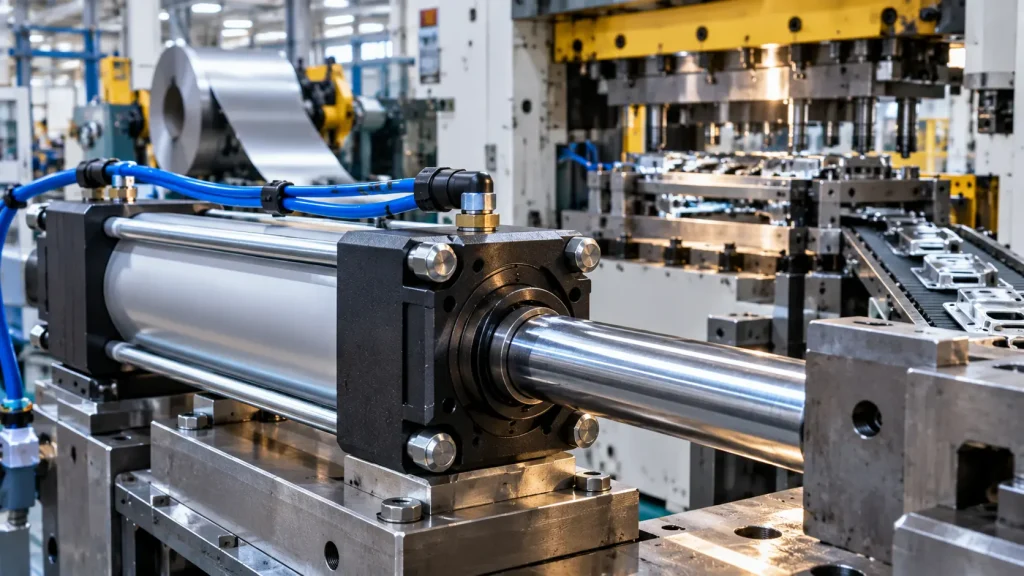
These are typically tie-rod cylinders, built with square end caps held together by four external tie rods, sometimes also called JIC cylinders. NFPA pneumatic cylinder standards cover a wide range of bore sizes and support numerous mounting configurations — flange, clevis, trunnion, foot, and more — which is a large part of why this format became the default across North American industrial equipment.
What Is the ISO Cylinder Standard?
ISO cylinders follow metric dimensional standards published by the International Organization for Standardization, rather than the inch-based NFPA system. The most widely adopted of these is ISO 15552, which covers cylinders with detachable mountings and superseded the older ISO 6431 standard; other ISO standards cover compact and short-stroke cylinder formats for tighter installations.
Like NFPA, the point of an ISO pneumatic cylinder standard is interchangeability — an ISO 15552 cylinder from one manufacturer should mount and perform the same as another manufacturer’s cylinder built to the same standard. ISO cylinders are common on machinery built for international or European markets, where metric hardware and fittings are already the norm.
What’s the Difference Between NFPA and ISO Cylinders?
The core difference comes down to units and origin: NFPA cylinder specifications are inch-based and rooted in North American industry practice, while ISO pneumatic cylinder standards are metric and used more broadly across international markets. That single difference cascades into everything else — bore sizes, rod threads, port locations, and mounting hole patterns are all dimensioned differently between the two systems.
Both standards achieve the same goal — dimensional interchangeability between manufacturers — but only within their own system. Pneumatic cylinder sizing and compatibility only applies cylinder-to-cylinder within the same standard; an NFPA cylinder and an ISO cylinder of similar output force will not share mounting dimensions. When engineers talk about NFPA vs. ISO pneumatic cylinders in a specification meeting, they’re usually really asking which installed base and parts supply chain the new equipment needs to match — not which standard is technically “better,” since both are equally rigorous within their own scope.
NFPA vs. ISO Cylinders: Side-by-Side Comparison
| Factor | NFPA Cylinders | ISO Cylinders |
|---|---|---|
| Unit system | Inch-based | Metric |
| Governing body | National Fluid Power Association | International Organization for Standardization |
| Construction | Typically tie-rod, square end caps | Varies by standard (tie-rod, compact, profile) |
| Primary market | North America | International, especially Europe |
| Interchangeability | Across NFPA-compliant manufacturers | Across ISO-compliant manufacturers |
Which Standard Do U.S. Manufacturers Need?
Most U.S. manufacturers should default to NFPA cylinders, simply because that’s what the existing installed base, tooling, and replacement-parts supply chain already run on. If a machine on the floor already uses an NFPA cylinder, replacing it with anything else means adapting mounting hardware and fittings that weren’t designed for a metric footprint.
ISO cylinders become the right call in more specific situations: equipment imported from a metric-standard country, machinery being built for export to international customers, or a company deliberately standardizing on ISO hardware across multiple global facilities. A plant running a mix of domestically built and imported equipment may genuinely need both standards on hand, which is worth planning for rather than discovering during an unplanned repair.
Outside of those cases, U.S. pneumatic cylinder standards work overwhelmingly through NFPA, and it’s worth confirming which one an existing machine actually uses before ordering a replacement. Checking the nameplate, existing mounting hardware, or the original equipment manufacturer’s documentation is usually enough to settle the question before parts are ordered.
Can NFPA and ISO Cylinders Be Used Interchangeably?
No — NFPA and ISO cylinders are not directly interchangeable, even when their bore size and force output are close. Mounting bolt patterns, port thread sizes, and overall envelope dimensions differ between the two standards, so a straight swap generally isn’t physically possible without adapter hardware.
Many manufacturers address this by offering both standards as separate product lines rather than trying to bridge them, which is the more reliable path if a facility genuinely needs both formats on-site.
Where Can You Find NFPA and ISO Cylinder Options?
Several vendors in Pneumation’s lineup build to these industrial cylinder specifications directly. AirTAC Standard NFPA Cylinders are built to the NFPA format outlined above, while AirTAC Compact Cylinders and AirTAC Guided Cylinders cover more space-constrained applications. Fabco Actuators and Fabco High-Force Actuators add NFPA-interchangeable options for heavier-duty force requirements, and Koganei High-Speed Cylinders round out the lineup for higher-cycle applications.
If you’re still narrowing down actuator type before worrying about standard, our guide on how to choose the right pneumatic actuator is a good starting point, and the full actuators category covers both NFPA and compact cylinder formats.
Frequently Asked Questions
The National Fluid Power Association, a standards body distinct from the National Fire Protection Association that shares the same acronym. NFPA cylinder standards define inch-based dimensions for interchangeability between manufacturers.
No. They use different unit systems and mounting dimensions, so an NFPA cylinder cannot directly replace an ISO cylinder, or vice versa, without adapter hardware.
NFPA is the standard most commonly specified and stocked in the U.S., since it matches the existing installed base of North American industrial equipment.
Some manufacturers offer metric equivalents alongside their standard NFPA lineup, but a true metric-bore cylinder built to ISO dimensions is still a separate standard with its own mounting pattern.
Yes. ISO 15552 superseded the older ISO 6431 standard and is now the most widely adopted ISO format for cylinders with detachable mountings.
Conclusion
NFPA and ISO cylinder standards solve the same problem — reliable interchangeability — for two different markets, and mixing them up leads to a replacement part that simply won’t bolt on. For most U.S. facilities, NFPA is the safe default; ISO only enters the picture when equipment, customers, or company standards call for metric hardware specifically.
If you’re not sure which standard your existing equipment uses, get in touch and we can help you confirm before you order.