Choose a profile rail when you need high load capacity, stiffness, and accuracy and can provide a flat, precise mounting surface. Choose a round rail when cost, simple installation, and tolerance for misalignment matter more than maximum rigidity. Profile rails are the standard for machine tools and precision automation, while round rails suit lighter, forgiving, or end-supported designs. The right answer depends on your load, accuracy target, mounting conditions, and budget.
What Is the Difference Between a Profile Rail and a Round Rail?
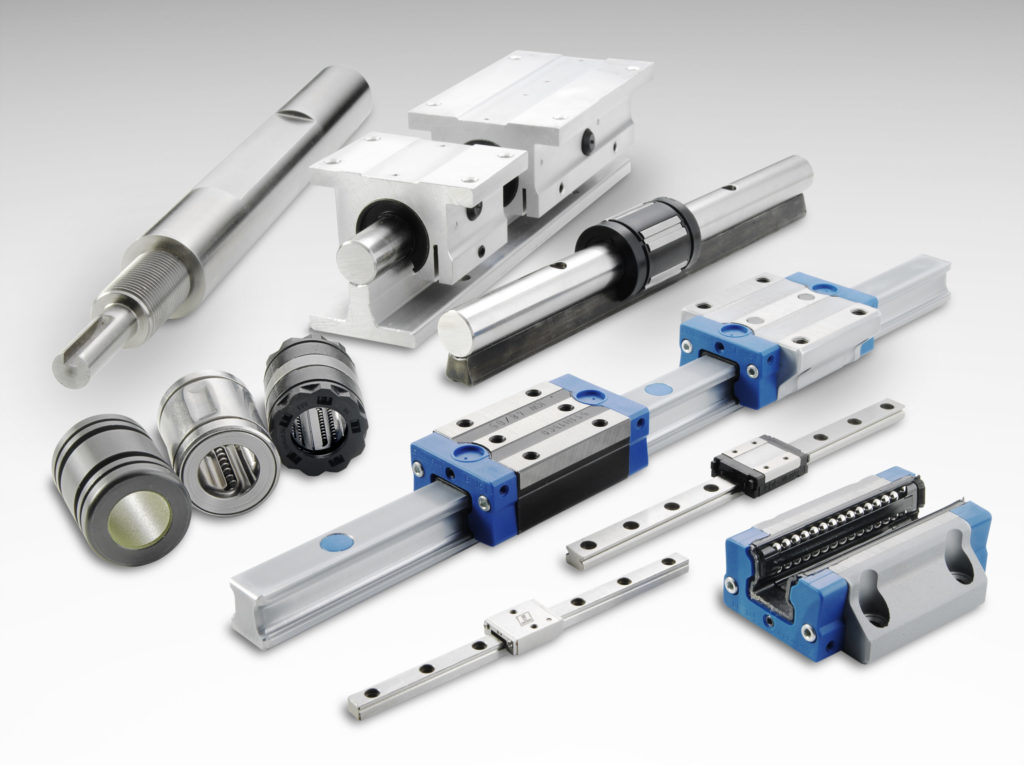
A profile rail is a precision-ground rail with a carriage (also called a block) that rides on recirculating balls or rollers, while a round rail is a hardened round shaft with a ball bushing that slides along it. Both guide linear motion, but they do it with different geometry, and that difference drives almost every trade-off below.
Profile rails, sometimes called square rails, have ground ball tracks that support load in several directions. Round rails use the curved shaft surface. As a result, round rails are simpler and more forgiving, and profile rails are stiffer and more precise. Both are types of linear motion bearings. For a broader introduction, see our guide on what linear guide rails are.
Round Rail vs. Profile Rail Linear Guide: Side-by-Side Comparison
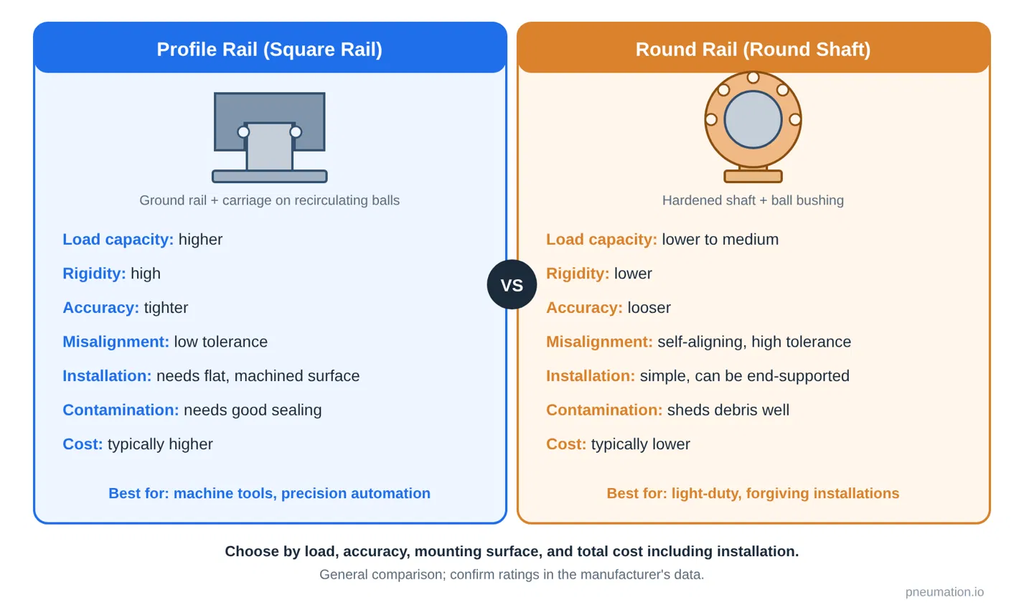
The table summarizes how the two designs compare on the factors most buyers weigh.
| Factor | Profile Rail | Round Rail |
|---|---|---|
| Load capacity | Higher | Lower to medium |
| Rigidity | High | Lower |
| Accuracy | Tighter | Looser |
| Misalignment tolerance | Low | High, self-aligning |
| Installation | Needs a machined, flat mounting surface | Simple, can be end-supported |
| Contamination | More complex sealing | Sheds debris well |
| Cost | Typically higher | Typically lower |
| Typical use | Machine tools, precision automation | Light-duty, forgiving installations |
These points are consistent with comparisons published by Linear Motion Tips and Machine Design. The sections below explain the biggest differences.
Profile Rail Linear Guide Load Capacity and Rigidity: How Do They Compare?
Profile rails carry more load and are considerably stiffer than round rails of similar size. Load capacity describes how much force the guide can support, and rigidity describes how little it deflects under that force. Together they decide how well a guide holds position under heavy or off-center loads.
According to Machine Design, profile bearings are roughly five times stiffer under load than round-rail assemblies, and a similar-sized profile guide can have up to three times the load capacity of a round ball bushing at the same travel life. Profile rails also support moments from a single rail, while a single round shaft cannot. These are published engineering comparisons, not guarantees for any specific product, so confirm ratings in the manufacturer’s data.
Ball and roller carriages also differ in load capacity and rigidity, which our earlier guide on linear rail types covers.
Profile Rail vs. Round Shaft Linear Guide: Which Is More Accurate?
Profile rails are more accurate, but only when the mounting surface is prepared well. Their ground tracks give tighter, more repeatable positioning, which is why they appear in CNC and semiconductor equipment. Round shafting can still position loads precisely, but its accuracy depends mainly on how accurately the end supports are mounted.
The trade-off is sensitivity. Machine Design notes that profile rails are very sensitive to flatness errors, which can cause binding, high drag, and shorter life, and that surfaces must be carefully prepared or shimmed. Round rails are self-aligning and tolerate poor parallelism and height variation far better.
Round Rail vs. Profile Rail Cost: Which Is Cheaper?
Round rails are typically the more economical choice, while profile rails typically cost more. Linear Motion Tips describes round rails as usually the cheapest option relative to component cost. Machine Design adds that profile rails were historically much more expensive because of the grinding required, though economies of scale have made them more competitive.
Look beyond the purchase price. A round rail needs no machined mounting surface, which lowers installation cost. A profile rail may need surface preparation but can deliver longer life under demanding loads. Consider total cost, including mounting, alignment, and expected service life, rather than rail price alone.
What Is the Difference Between a Linear Guide Rail and a Linear Bearing?
A linear guide rail is the track, and a linear bearing is the moving element that rides on it. In a profile system, the carriage or block is the bearing. In a round system, the ball bushing is the bearing and the shaft is the guide. Together they form the linear guide system.
The terms are often used loosely, so check what a supplier means. “Linear guide” can refer to the whole assembly, while “linear bearing” may mean only the bushing or block.
How to Choose a Linear Guide System
Work through these questions in order:
- How heavy is the load, and is it off-center? Heavy or moment loads favor profile rails.
- How accurate must the motion be? Tight accuracy favors profile rails.
- What mounting surface do you have? A rough or unmachined structure favors round rails. A flat, machined surface suits profile rails.
- Is the environment dirty? Round rails shed debris naturally, and profile rails need good sealing.
- What is your budget, including installation? Round rails usually win on cost.
- Is the rail supported along its length or only at the ends? Only round shafts can span gaps with end supports.
If you are still weighing options, our linear guide rails page lists the available systems from AirTAC.
Where Are Profile and Round Rails Used?
Profile rails are common in machine tools, inspection stations, and industrial automation, where load, stiffness, and accuracy matter. They also appear in electronics and semiconductor equipment and general industrial manufacturing machinery. Round rails appear in gantry systems, pick-and-place modules, and lighter equipment where an installation is forgiving.
Linear guides often work alongside pneumatic or electric drives. AirTAC guided cylinders and rodless magnetic cylinders add guidance to pneumatic motion, and the electrical motion category covers motor-driven axes. For a non-standard machine design, see our custom solutions.
Frequently Asked Questions
Neither is better in every case. Profile rails offer higher load capacity, rigidity, and accuracy. Round rails offer lower cost and easier installation.
Generally yes. Profile rails carry higher loads and are stiffer than round rails of similar size, and they can support moments from a single rail.
Typically yes. Round rails are usually the more economical option, especially since they need no machined mounting surface.
Possibly, but the mounting surface must be flat and precise. A profile rail is much less tolerant of misalignment than a round rail.
The guide is the rail or shaft, and the bearing is the carriage or bushing that moves along it. Together they form the linear guide system.
Conclusion
Profile rails and round rails solve the same problem in different ways. Profile rails deliver stiffness, load capacity, and accuracy when the mounting is precise, while round rails offer low cost and forgiveness when it is not. Start with load, accuracy, mounting, and budget, and the right system usually becomes clear.
If you are specifying a linear guide for a new machine or an upgrade, get in touch and we can help you match the system to your application.