Specifying the wrong actuator rarely shows up as a dramatic failure on day one. More often, it shows up months later as sluggish cycle times, premature wear, or a machine that just can’t quite hit the throughput it was designed for. Getting pneumatic actuator selection right at the design stage saves far more time than fixing it after installation. This guide walks through what a pneumatic actuator actually does, the main types available, and the practical criteria that separate a correct choice from a costly guess.
What Is a Pneumatic Actuator?
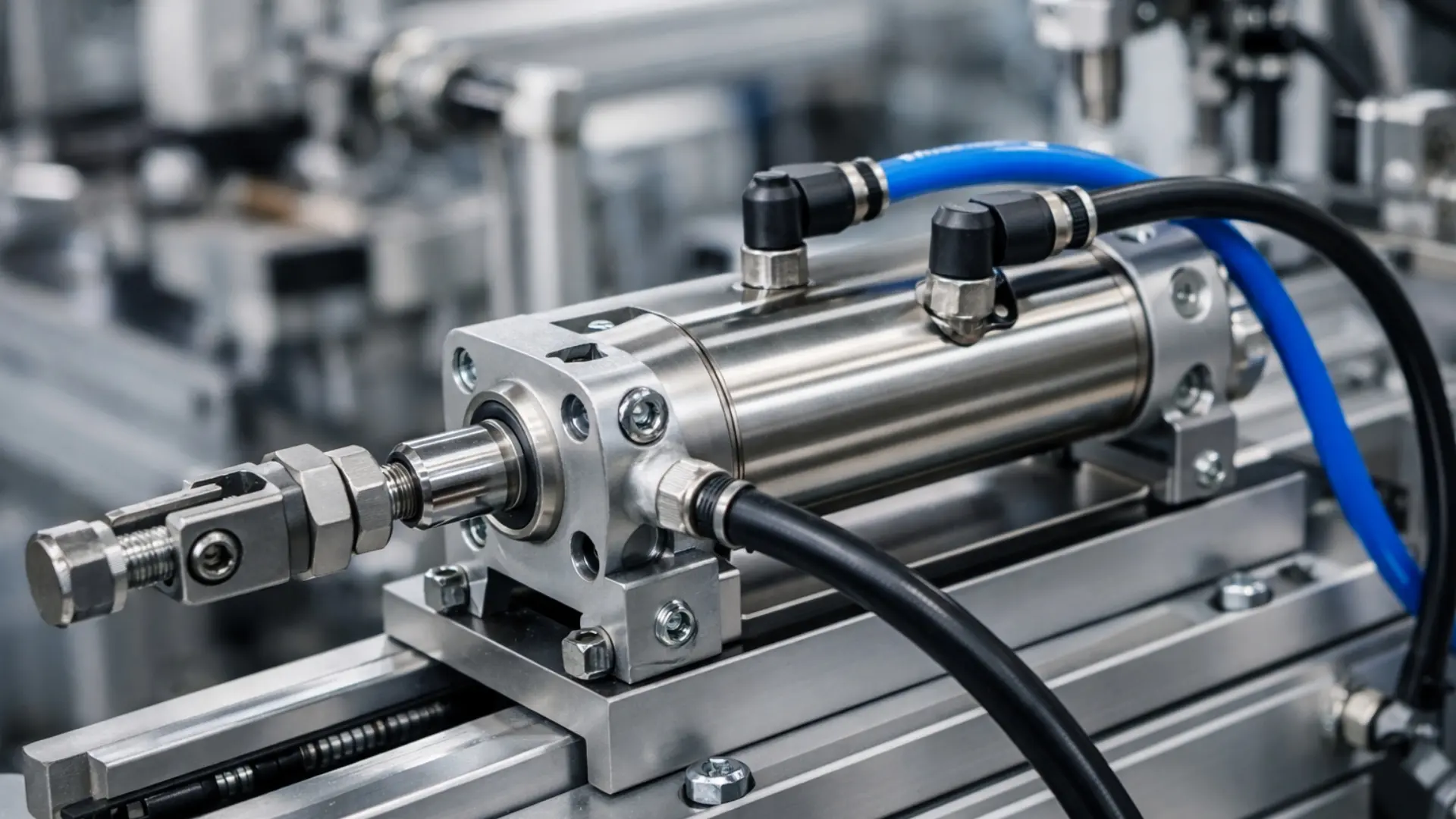
A pneumatic actuator converts compressed air into mechanical motion, either linear (push-pull) or rotary (turning). Air enters a chamber and acts on a piston or vane, generating force that moves a rod, table, or shaft to perform work: clamping a part, opening a valve, or rotating a fixture. Compared with electric or hydraulic alternatives, pneumatic actuators are valued for their simplicity, fast response, and tolerance for repetitive duty cycles in demanding environments.
Because compressed air systems are already standard infrastructure in most factories, pneumatic actuator applications tend to be easier and cheaper to deploy at scale than electromechanical alternatives, particularly where absolute positioning accuracy isn’t the primary requirement.
Types of Pneumatic Actuators
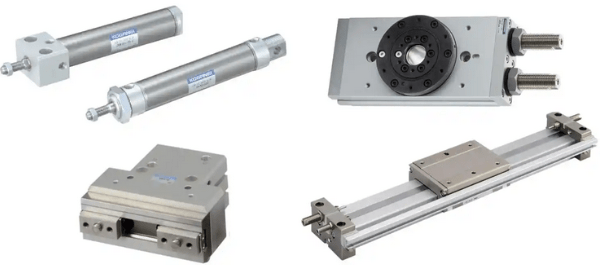
Before choosing a pneumatic actuator, it helps to know what’s actually on the table. The major types of pneumatic actuators cover a wide range of motion profiles and mounting styles:
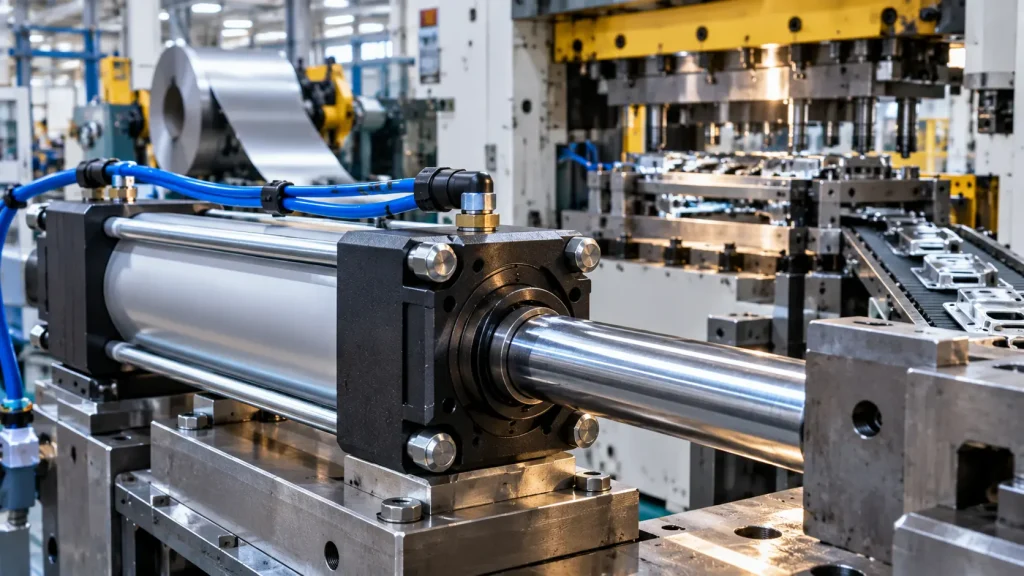
- Standard cylinders — the workhorse of linear motion, available in NFPA-standard configurations such as AirTAC Standard NFPA Cylinders, suited to general push-pull tasks.
- Compact cylinders — shorter overall length for tight installation spaces, as seen in AirTAC Compact Cylinders.
- Guided cylinders — twin-rod designs that resist rotation and side-loading, such as AirTAC Guided Cylinders, useful where a load must stay precisely aligned.
- Rodless cylinders — magnetically coupled designs like the AirTAC Rodless Magnetic Cylinder, ideal where space along the stroke axis is limited.
- Rotary actuators — convert air pressure into rotational motion, such as Fabco Rotary Actuators or AirTAC Rotary Table Cylinders, used for indexing, flipping, or turning parts.
- High-force actuators — heavier-duty designs like Fabco High Force Actuators, built for demanding clamping or pressing tasks.
- High-speed and clean room cylinders — specialized options such as Koganei High Speed Cylinders and Koganei Clean Room Pneumatic Equipment, designed for rapid cycling or contamination-sensitive environments.
Each of these represents a different answer to the same underlying question: what kind of motion, in what space, under what conditions?
Where Industrial Pneumatic Actuators Are Used
Industrial pneumatic actuators show up wherever a machine needs to push, pull, clamp, lift, or rotate something repeatedly. Typical applications include:
- Clamping and holding fixtures during machining or welding
- Opening and closing valves or gates in process lines
- Indexing tables and rotating parts between workstations
- Ejecting or sorting parts on packaging and assembly lines
- Operating grippers and end-of-arm tooling on robotic cells
Across food processing, automotive assembly, electronics manufacturing, and general industrial automation, actuators are usually one part of a larger pneumatic circuit alongside valves and air preparation equipment. Their reliability under constant cycling is a large part of why pneumatic solutions remain a default choice for repetitive industrial motion tasks.
How to Choose a Pneumatic Actuator: Key Selection Criteria
Once you understand what’s available, the real question becomes how to select a pneumatic actuator that matches your specific task rather than just the closest catalog match. A handful of criteria typically drive the decision:
Motion type. Does the application need linear push-pull motion, or rotational movement? This alone usually narrows the field to either cylinders or rotary actuators before anything else is considered.
Force requirement. The actuator must generate enough force to move, clamp, or hold the load reliably, with some margin for friction and unexpected resistance, without being so oversized that it wastes air and space.
Stroke length and mounting space. Available installation space often rules out standard cylinders in favor of compact or rodless designs, particularly in machines with limited depth along the axis of travel.
Speed and cycle rate. Applications that cycle rapidly and continuously benefit from actuators specifically rated for high-speed operation, rather than standard cylinders pushed beyond their intended duty cycle.
Environmental conditions. Washdown environments, cleanrooms, or areas with contaminants call for actuators built with appropriate seals and materials for that setting.
Mounting and guidance needs. Where side loads or precise alignment matter, guided cylinders prevent the rod from rotating or drifting off-axis in ways a standard cylinder would allow.
Pneumatic Actuator Sizing
Choosing a pneumatic actuator is only half the job; correct pneumatic actuator sizing is what determines whether it performs reliably under real load. Sizing starts with the force the actuator must generate, which depends on the bore diameter and the available supply pressure — larger bores or higher pressure both increase output force, but at the cost of higher air consumption.
Beyond raw force, sizing also has to account for friction losses, the mass and speed of the load being moved, and a reasonable safety margin so the actuator isn’t running at its absolute limit during every cycle. Undersized actuators struggle under load and wear out prematurely, while oversized ones waste compressed air and increase operating costs over the life of the machine. Because these trade-offs interact, sizing is usually best worked through with reference to the manufacturer’s rated force and pressure curves for the specific model under consideration, rather than estimated from general rules of thumb alone.
Pneumatic Cylinder Selection vs. Rotary Actuator Selection
Linear and rotary actuators solve different problems, and the selection logic for each differs accordingly. The comparison below highlights where the two typically diverge.
| Criteria | Pneumatic Cylinder Selection | Rotary Actuator Selection |
|---|---|---|
| Motion produced | Linear push-pull | Rotational (partial or continuous turn) |
| Typical use | Clamping, pushing, lifting, ejecting | Indexing, flipping, turning fixtures or parts |
| Key sizing factor | Bore size vs. required force and stroke | Torque output vs. load inertia and rotation angle |
| Space consideration | Stroke length along a single axis | Mounting footprint and rotational clearance |
| Example product | AirTAC Standard NFPA Cylinders | Fabco Rotary Actuators |
In practice, many machines use both: a cylinder to advance a part into position and a rotary actuator to turn or index it once it arrives.
Common Mistakes to Avoid
A few recurring mistakes tend to undermine otherwise sound actuator choices. Selecting based on bore size alone, without checking actual force requirements against system pressure, is one of the most common. Ignoring side loads on standard cylinders, rather than specifying a guided design where alignment matters, is another frequent source of premature wear. Overlooking environmental factors, such as installing a standard cylinder in a washdown or cleanroom application, can shorten service life considerably. Finally, treating actuator selection as an isolated decision, rather than considering it alongside the valves and air preparation equipment that support it, often leads to a mismatch between components down the line.
Conclusion
Choosing a pneumatic actuator comes down to matching motion type, force, space, and environment to the right category of product, then sizing it correctly against the real-world load it will face. With linear and rotary options covering everything from compact clamping tasks to high-force pressing and rapid indexing, there’s rarely a shortage of suitable hardware. What matters is working through the selection criteria deliberately, rather than defaulting to a familiar cylinder size out of habit. Getting this right at the specification stage pays off in fewer failures, lower air consumption, and a machine that performs the way it was designed to from the first cycle onward.