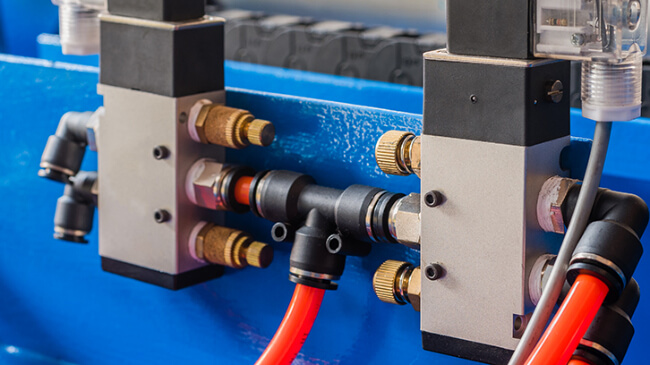
So, what is a solenoid valve? It’s an electromechanical valve that uses an electric coil to control the flow of air, gas, or liquid through a system. When the coil is energized, it generates a magnetic field that moves an internal plunger, opening or closing the valve’s flow path. Because they respond to an electrical signal rather than manual operation, solenoid valves are the standard choice for automated flow control in pneumatic, hydraulic, and process systems across manufacturing, HVAC, and fluid handling applications.

How Does a Solenoid Valve Work?
A solenoid valve works by converting an electrical signal into mechanical motion that opens or closes a flow path. The same basic principle applies whether the valve is controlling compressed air on a factory floor or water in an irrigation line.
The cycle generally follows four steps:
- De-energized state. With no power applied, a spring holds the plunger in its default position — closed for a normally closed valve, open for a normally open valve.
- Coil energized. Electric current passes through the solenoid coil, generating a magnetic field.
- Plunger moves. The magnetic field pulls the plunger (also called the armature) away from, or into, the orifice, changing the valve’s position.
- Flow changes. Fluid or gas is now allowed to pass, or is blocked, depending on the valve’s design.
When power is removed, the spring returns the plunger to its resting position. This working principle is what makes solenoid valves fast, repeatable, and easy to integrate with programmable logic controllers (PLCs) and other automation systems, since they require no mechanical linkage to a human operator.
What Are the Different Types of Solenoid Valves?
Solenoid valves are typically classified in two ways: by how they’re actuated (direct-acting or pilot-operated) and by their default position when de-energized (normally open or normally closed).
Direct-Acting vs. Pilot-Operated Solenoid Valves
A direct-acting solenoid valve uses the force of the coil alone to open or close the valve, with no reliance on system pressure. Because it doesn’t need a minimum pressure differential to operate, it works reliably at very low pressures, in a vacuum, or with zero flow.
A pilot-operated solenoid valve uses a small solenoid-actuated pilot to redirect a portion of the system’s own pressure, which then moves a larger main diaphragm or piston to open the main flow path. This design lets a small coil control a much larger valve and higher flow rates, but it typically needs a minimum pressure differential to function correctly.
| Feature | Direct-Acting | Pilot-Operated |
|---|---|---|
| Actuation | Coil moves the valve directly | Coil operates a small pilot, which uses system pressure to move the main valve |
| Minimum pressure differential | Not required | Typically required |
| Best suited for | Low-flow, vacuum, or zero-pressure applications | Higher-flow applications with adequate line pressure |
| Response | Direct and immediate | Depends partly on system pressure |
Humphrey Air Piloted Valves are a practical example of this pilot-operated design, built for higher-capacity pneumatic circuits.
Normally Open vs. Normally Closed Solenoid Valves
A normally closed solenoid valve stays shut when de-energized and opens only once power is applied. This is the more common configuration, since it defaults to a safe, no-flow state if power is lost — useful for shutting off compressed air, fuel, or water automatically during an outage.
A normally open solenoid valve does the opposite: it stays open with no power and closes only when energized. This configuration is used where flow, or venting, needs to continue if electrical power is interrupted.
Solenoid valves are also grouped by the number of ports and flow paths they control — 2-way, 3-way, and 5-way configurations — which determine whether a valve simply switches flow on and off or directs it between multiple outlets.
Beyond simple on/off control, proportional solenoid valves — such as the Humphrey ProControl Proportional Valves — use a variable electrical signal to modulate flow across a range of positions, rather than switching fully open or fully closed.
What Is the Function of a Solenoid Valve?
The core function of a solenoid valve is to start, stop, or redirect the flow of a fluid or gas automatically, without anyone operating it by hand. That makes it a fundamental building block of automated pneumatic and fluid power systems.
Common applications include:
- Controlling pneumatic actuators and cylinders in industrial automation
- Regulating water flow in irrigation and municipal systems
- Managing air or refrigerant flow in HVAC equipment
- Dosing or shutting off fluids in food and beverage processing
- Controlling gas flow in laboratory, medical, and analytical instruments
- Directing compressed air in packaging and material-handling equipment
Manufacturers such as Humphrey Products and Airtac produce solenoid valves for many of these applications, including standard lines like Humphrey Solenoid Valves and AirTAC Solenoid Valves, built for continuous industrial duty cycles.
What Are the Basic Components of a Solenoid Valve?
A few key terms make it easier to understand how a solenoid valve is built and specified:
- Coil (solenoid): The wound wire coil that generates a magnetic field when current passes through it.
- Plunger (armature): The moving metal core that the magnetic field pulls to open or close the valve.
- Spring: Returns the plunger to its default position once the coil is de-energized.
- Orifice: The opening inside the valve body that the plunger seals or uncovers to control flow.
- Valve body: The housing that contains the internal components and connects to the piping or tubing.
These parts work together in every solenoid valve, whether it’s a small direct-acting valve on a benchtop instrument or a pilot-operated valve on an industrial air line — a structure also documented in general engineering references such as Wikipedia’s overview of solenoid valves.
Frequently Asked Questions
A solenoid valve opens and closes automatically in response to an electrical signal, while a manual valve requires someone to operate it by hand, such as turning a handle or lever.
A normally closed valve stays shut when it has no power and opens only once the coil is energized. It’s the most common configuration because it defaults to a safe, no-flow state if power is lost.
A normally open valve stays open with no power applied and closes only when energized — used where flow or venting needs to continue if power fails.
A direct-acting valve is opened and closed by the coil alone, with no minimum pressure required. A pilot-operated valve uses the coil to control a small pilot valve, which then uses system pressure to move a larger main valve, allowing higher flow rates.
Only to hold their non-default position: a normally closed valve needs continuous power to stay open, and a normally open valve needs continuous power to stay closed. Once power is removed, a spring returns the valve to its default state.
Conclusion
A solenoid valve is one of the simplest and most reliable ways to automate flow control, converting an electrical signal into precise, repeatable mechanical motion. Choosing between direct-acting or pilot-operated, and normally open or normally closed, comes down to the pressure, flow rate, and fail-safe behavior your application requires.
To see how solenoid valves fit into a complete pneumatic circuit, browse our full range of pneumatic valves or get in touch to discuss the right configuration for your system.