A ball valve is built for on/off shutoff — a quarter-turn rotation fully opens or closes the flow path. A control valve is built to hold a precise position anywhere in between, continuously adjusting flow, pressure, or another process variable in response to a signal from a controller. Using a ball valve where a control valve belongs, or the reverse, is one of the most common process valve selection mistakes, and it usually shows up as poor control or unnecessary cost.
What Is a Ball Valve?
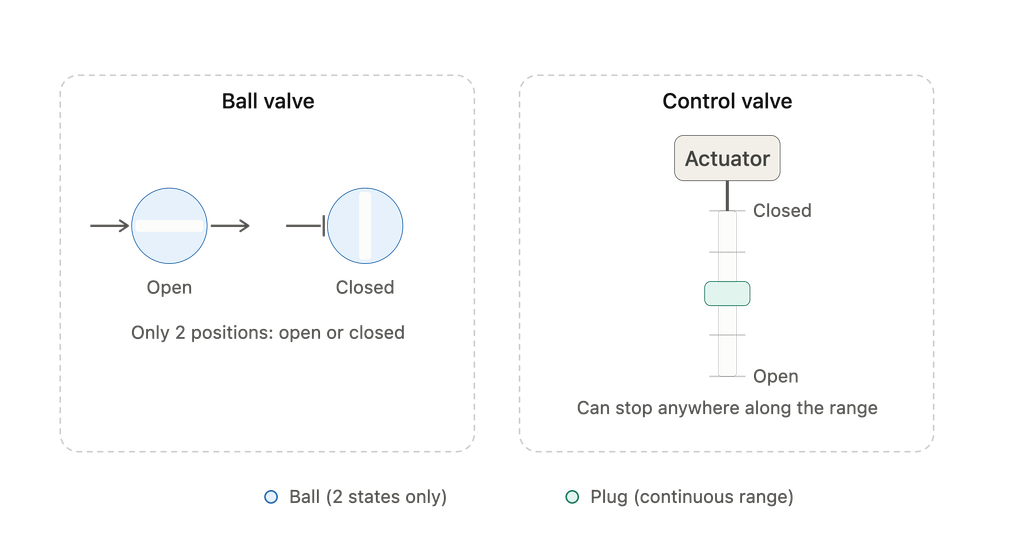
A ball valve is a quarter-turn shutoff valve that uses a rotating ball with a bore through its center to allow or block flow. Turning the handle 90 degrees aligns the bore with the pipeline to open the valve, or turns it perpendicular to block flow entirely, and the handle’s position gives an immediate visual check of whether the valve is open or closed.
Ball valves are known for durability and reliable sealing even after long periods sitting idle, which is why they’re often preferred over gate and globe valves for shutoff duty. As Wikipedia’s overview of ball valves notes, that same design that makes them excellent at shutoff also means they lack the fine control that throttling applications need.
What Is a Control Valve?
A control valve is a valve engineered to continuously modulate flow, pressure, or another process variable rather than simply switch between open and closed. It receives a signal from a controller and adjusts its position accordingly, most commonly through a linear-motion plug moving inside a globe-style body, though rotary designs are also used.
Control valves are typically automated with a pneumatic, electric, or self-powered actuator, since the whole point is responding continuously to changing process conditions rather than being set once by hand. Habonim’s control valve line is built around this same throttling function, engineered for process applications that need ongoing adjustment rather than a simple on/off switch.
What’s the Real Difference Between a Ball Valve and a Control Valve?
The real difference between a ball valve and a control valve comes down to purpose: one is a shutoff valve, the other is a throttling valve. A ball valve is meant to be fully open or fully closed; a control valve is meant to sit anywhere in between and stay there reliably, adjusting as conditions change.
That distinction drives everything else about how each valve is built — the ball valve’s simple bore-through-a-sphere design is ideal for quick, tight shutoff, while a control valve’s plug-and-seat geometry is shaped specifically to give predictable flow change across its full travel.
On/Off Valve vs. Throttling Valve: Why Rangeability Matters
An on/off valve vs. throttling valve comparison usually comes down to one concept: rangeability, or how precisely a valve can control flow across its full range of positions, not just at fully open or fully closed. A standard ball valve has poor rangeability for throttling, because most of the flow change happens in a narrow band near the closed position, leaving little useful control across the rest of its travel.
A control valve’s plug and seat are shaped specifically to avoid that problem, giving a more predictable, linear, or equal-percentage flow response as the valve moves. This is why rangeability, not just flow capacity, is the number to check when a valve needs to do more than simply turn something on or off.
Can a Ball Valve Be Used as a Control Valve?
A standard ball valve can technically be used as a control valve, but it generally performs poorly in that role because its flow characteristic isn’t built for it. Most of the change in flow happens in a narrow range near closed, and mechanical play between the stem and ball adds further imprecision — fine for a rough adjustment, not for accurate process control.
Specialized versions close part of that gap. A segmented or V-port ball valve uses a shaped opening instead of a plain round bore, giving it meaningfully better rangeability than a standard ball valve, though still generally not matching a purpose-built control valve.
Ball Valve vs. Control Valve: Side-by-Side Comparison
| Factor | Ball Valve | Control Valve |
|---|---|---|
| Primary function | On/off shutoff | Continuous throttling |
| Motion type | Quarter-turn (rotary) | Typically linear (plug and seat) |
| Rangeability | Limited | Designed for wide, predictable range |
| Typical actuation | Manual or simple automated | Pneumatic, electric, or self-powered actuator |
| Best fit | Isolation, shutoff, basic on/off | Precise flow, pressure, or level control |
How Do You Choose Between a Ball Valve and a Control Valve?
Choose a ball valve when the job is isolation or shutoff — stopping or starting flow completely, with no need to hold an intermediate position. Ball valves are also the practical choice when reliability after long idle periods and low-maintenance operation matter more than fine control.
Choose a control valve when the process genuinely needs to hold a variable position in response to changing conditions — regulating pressure, maintaining a flow rate, or controlling a liquid level. If a controller needs to actively adjust the valve based on live process data, that’s a control valve application, not a shutoff valve application.
Where Are Ball Valves and Control Valves Used in Process Automation?
Ball valves and control valves both show up throughout process industries, often on the same system performing different roles — a ball valve isolating a section of line for maintenance, and a control valve continuously regulating flow through it during operation. This pattern is especially common across energy and natural resources applications, where both shutoff and precise control are needed side by side.
Habonim builds both valve types on shared design principles, including hydrogen service valves built around the same ball-valve shutoff function, and the HermetiX stem sealing system used across much of the line. Pneumation’s full process automation lineup covers both valve types for new builds and replacements.
Frequently Asked Questions
A ball valve is built for on/off shutoff using a quarter-turn rotating ball, while a control valve is built to continuously adjust flow, pressure, or another process variable in response to a control signal.
Technically yes, but a standard ball valve generally performs poorly at precise throttling. Segmented or V-port ball valves narrow that gap, though a purpose-built control valve still typically offers better control.
It’s a measure of how precisely a valve can control flow across its full range of positions, not just at fully open or fully closed. Control valves are specifically engineered for wide, predictable rangeability.
Yes. A ball valve opens or closes with a 90-degree rotation of the handle, which is part of why it’s fast to operate and easy to check visually for open or closed status.
Primarily shutoff. Ball valves excel at reliable on/off isolation, while precise, continuous flow control is generally better handled by a control valve designed specifically for that purpose.
Conclusion
Ball valves and control valves solve different problems even though both are common process valve types: one is built to be fully open or fully closed, the other to hold any position in between. Matching the valve to the job — shutoff versus continuous control — is the decision that actually determines performance, not which valve happens to be on hand.
If you’re specifying valves for a process system and aren’t sure which type fits a given point in the line, get in touch and we’ll help you match the valve to the application.