A vacuum generator is a device that uses compressed air to create vacuum, with no motor and no moving parts in the vacuum stage. Air flowing through a narrow nozzle speeds up, pressure drops, and suction is drawn from a port connected to a vacuum cup or chamber. A vacuum pump gets the same result with an electric motor. So which one is right for your machine? That depends on your air supply, cycle speed, and how much suction flow you need.
What Is a Vacuum Generator?
A vacuum generator is a compact pneumatic device that turns a stream of compressed air into vacuum. It is most often used to power suction cups that pick up, hold, and move parts in automated equipment.
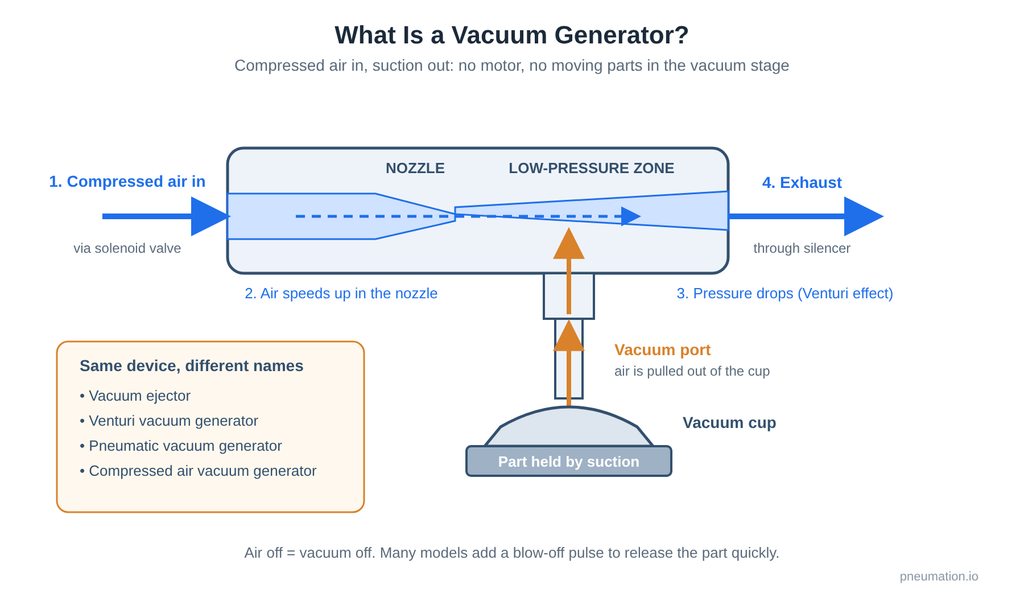
You will see several names for the same thing:
- Vacuum ejector: the most common alternative term, used by many manufacturers.
- Pneumatic vacuum generator: emphasizes that it runs on compressed air.
- Venturi vacuum generator: refers to the physical principle behind it.
- Compressed air vacuum generator: another way of saying the same thing.
Because there is no motor, a vacuum generator is small, light, and can be mounted right next to the suction cup. That short distance between source and cup is a big reason these devices are so common on robot grippers and pick-and-place heads. Our vacuum systems and pads category covers generators together with the cups they typically drive.
How Does a Vacuum Generator Work?
A vacuum generator works by sending compressed air through a nozzle, which creates a low-pressure zone that pulls air out of the vacuum port. The process follows a simple sequence:
- Compressed air enters. A supply line, usually switched by a solenoid valve, feeds air into the generator.
- The air accelerates. It passes through a narrow nozzle and speeds up sharply.
- Pressure drops. The fast-moving jet creates a low-pressure area in the chamber behind the nozzle.
- Suction is drawn. Air from the vacuum port is pulled into that low-pressure area.
- Air exits together. Supply air and extracted air leave through the exhaust, often through a silencer.
When the air is switched off, vacuum stops. Many designs add a blow-off function that sends a short puff of air to the cup to release the part quickly. For example, the PISCO VY series combines an ejector and blow-off in one body.
What Is the Venturi Effect?
The Venturi effect is the drop in fluid pressure that occurs when a fluid moves through a constricted section of a pipe. It follows from the principle that faster-moving fluid has lower pressure, and it is the physical basis of the Venturi effect explained in general engineering references. A Venturi vacuum generator applies it on purpose: the nozzle is the constriction, and the pressure drop is the vacuum.
What Is the Difference Between Single-Stage and Multi-Stage Vacuum Generators?
A single-stage vacuum generator uses one nozzle, while a multi-stage vacuum generator places several nozzles in series. Multi-stage designs use the same compressed air to move more air from the vacuum port, which gives higher suction flow. That helps when you need to evacuate a larger volume quickly or work with porous surfaces.
| Feature | Single-Stage | Multi-Stage |
|---|---|---|
| Nozzle design | One nozzle | Several nozzles in series |
| Suction flow for same air supply | Lower | Higher |
| Size | Very compact | Slightly larger |
| Best suited for | Non-porous parts, small cups, simple tasks | Larger cups, porous parts, faster evacuation |
Some generators also come as compact units with integrated valves or vacuum monitoring, which reduces plumbing. The PISCO vacuum generators range shows how varied the formats are: the VH and VS series are ejectors with a built-in push-in fitting for direct valve mounting, the VU series allows conversion from compressed air to vacuum in one line, and the VY series pairs the ejector with blow-off. You can browse the full lineup under PISCO.
Vacuum Generator vs. Vacuum Pump: What Is the Difference?
The main difference is the power source: a vacuum generator runs on compressed air, while an electric vacuum pump runs on a motor. A vacuum pump removes gas from a sealed volume mechanically, so it needs electricity, not an air supply.
| Factor | Vacuum Generator | Electric Vacuum Pump |
|---|---|---|
| Power source | Compressed air | Electric motor |
| Moving parts | None in the vacuum stage | Yes (rotor, vanes, or diaphragm) |
| Response time | Very fast when mounted at the cup | Depends on tubing length and volume |
| Maintenance | Low, mainly silencer and filter care | Higher, wear parts and service |
| Running cost driver | Compressed air consumption | Electricity |
| Typical duty | Intermittent, cycle-based picking | Continuous, centralized vacuum |
Neither option is better in every case. A generator tends to fit machines that already have clean compressed air and need quick, localized vacuum. A pump tends to fit applications that need continuous, high-volume vacuum for many cups at once. Because generators consume compressed air only while running, switching them off between picks is a common way to keep air use down.
Where Are Pneumatic Vacuum Generators Used?
Pneumatic vacuum generators are used wherever parts must be lifted, held, or placed automatically. Common examples include:
- Industrial manufacturing: robot end-of-arm tooling, sheet handling, and part transfer in industrial manufacturing plants.
- Packaging: picking cartons, bags, and containers in food processing and packaging lines.
- Electronics: gentle handling of small, delicate parts in electronics and semiconductor assembly.
In every case, performance depends on the whole path: the generator, tubing, and the vacuum cups must be matched to the part’s surface and weight. Because generators rely on compressed air, the quality of that air matters too. Clean, dry, correctly regulated air from properly sized air preparation systems helps protect the small nozzle from contamination and keeps vacuum levels consistent.
Frequently Asked Questions
It is a small device that uses a jet of compressed air to create suction. There is no motor involved, which is why it is light and easy to mount near a vacuum cup.
Yes, in most cases. “Vacuum ejector,” “Venturi vacuum generator,” and “pneumatic vacuum generator” all describe a compressed-air-powered device that creates vacuum using the Venturi effect.
Yes. Compressed air is its only energy source. Without an air supply, it cannot produce vacuum, which is the key reason some applications use an electric pump instead.
Not always. A generator suits fast, localized, intermittent vacuum. A pump suits continuous or high-volume vacuum. The better choice depends on your air supply, duty cycle, and the number of cups you need to serve.
A single-stage unit has one nozzle. A multi-stage unit uses several nozzles in series to deliver higher suction flow from the same compressed air, which helps with larger cups or porous parts.
Conclusion
A vacuum generator is a simple, motor-free way to turn compressed air into suction using the Venturi effect. It excels at fast, compact, cycle-based vacuum, while an electric vacuum pump is the stronger fit for continuous, high-volume demand. Matching the generator type, stage design, and air supply to your cups and parts is what makes a pick-and-place system reliable.
If you are specifying vacuum components for a new or existing machine, get in touch and we can help you match generators, cups, and air supply to your application.