Linear guide rails are a linear motion guide system that lets a carriage travel along a fixed rail in a perfectly straight line, using recirculating balls or rollers to keep friction low and positioning precise. The two main types — ball bearing and roller — differ mainly in how much load and rigidity they can handle: ball guides suit most general automation work, while roller guides step in when a machine needs higher load capacity and stiffness in a smaller footprint.
What Are Linear Guide Rails?
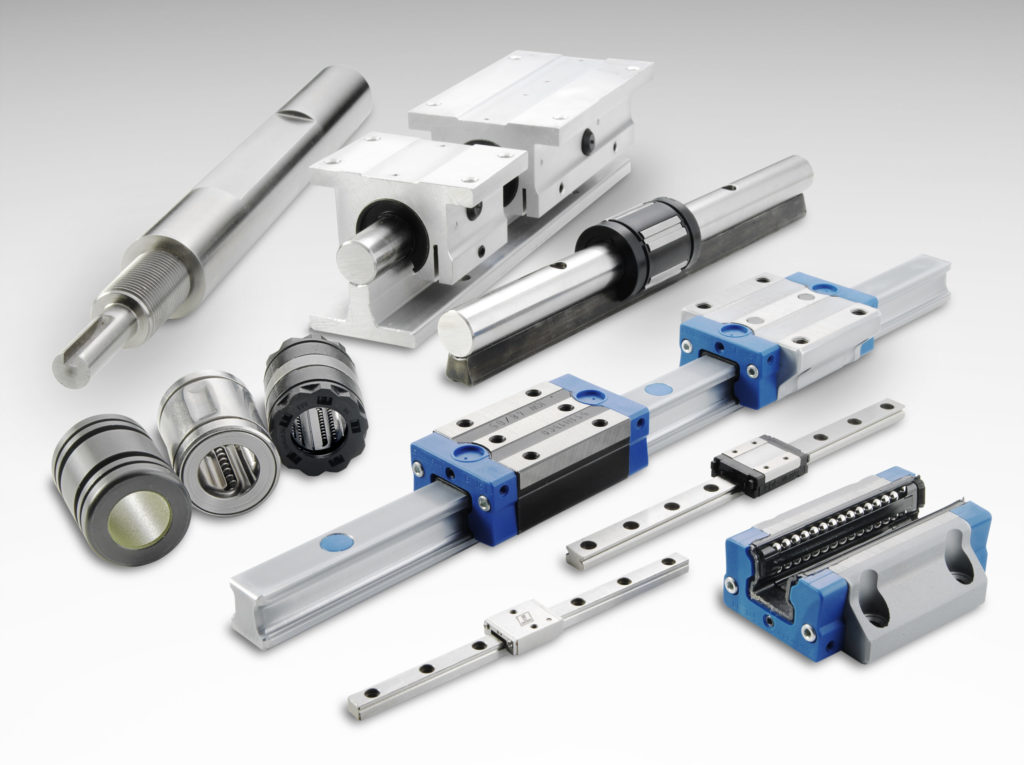
A linear guide rail is a hardened steel track paired with a moving carriage, or block, that rides along it on rolling elements to deliver smooth, accurate straight-line motion. Rather than sliding directly against the rail, the carriage rolls along it, which keeps friction low and positioning repeatable over millions of cycles.
This combination — rail plus carriage — is what most engineers mean by a linear guide, and it shows up anywhere a machine needs to move a load precisely along one axis: CNC tables, robotic end effectors, and automated slides among them. As a category of linear-motion bearing, guide rails are prized for combining smooth motion with high rigidity and a long service life.
How Do Linear Guide Rails Work?
A linear guide rail works by circulating rolling elements — balls or rollers — between a load-bearing raceway and a return path built into the carriage. As the carriage moves, elements under load roll along the rail, then cycle back through the carriage to rejoin the front of the load path, allowing continuous travel rather than a fixed, limited stroke.
This recirculating design is what lets a linear rail bearing support unlimited travel length along a rail, unlike simpler non-recirculating slides limited by the bearing’s own length. The rolling elements themselves are where ball and roller guides part ways.
What Are the Main Types of Linear Guide Rails?
Linear guide rails types are classified several ways — by rail profile, by size, and by load rating — but the most fundamental split is by rolling element: ball bearing or roller. Both are rolling element guides at heart, meaning the choice of ball versus roller affects nearly everything else about how the guide performs, which is why it’s usually the first decision made when specifying a system.
What Is a Ball Bearing Linear Guide Rail?
A ball bearing linear guide rail uses hardened steel balls as the rolling element between the carriage and the rail, making point contact with the raceway at each ball. This is the most common configuration in general industrial automation, largely because it performs well across a wide range of loads while staying comparatively inexpensive and simple to install.
Point contact also gives ball guides a practical advantage: they tolerate small installation misalignments better than roller designs, since the contact area doesn’t concentrate force onto as narrow a line. For machines without extreme load or rigidity requirements, a ball guide is typically the more forgiving and cost-effective choice.
What Is a Roller Linear Guide Rail?
A roller linear guide rail uses cylindrical or barrel-shaped rollers instead of balls, which make line contact with the raceway rather than point contact. That larger contact area lets roller guides carry significantly higher loads and deliver greater rigidity than a ball guide of the same physical size.
This is why roller guides show up most often on machine tools, heavy gantries, and robotics applications where stiffness under load directly affects precision. The tradeoff is cost and installation tolerance: roller guides run more expensive, and their high rigidity means small misalignments during installation can raise friction and shorten service life more noticeably than they would on a ball guide.
Ball Bearing vs. Roller Linear Guide Rails: Side-by-Side Comparison

| Factor | Ball Bearing Guides | Roller Guides |
|---|---|---|
| Contact type | Point contact | Line contact |
| Load capacity | Moderate | High, for the same size |
| Rigidity | Good | Excellent |
| Cost | Lower | Higher |
| Tolerance for misalignment | More forgiving | Less forgiving |
| Typical use | General automation | Machine tools, heavy or precision loads |
How Do Load Capacity and Rigidity Differ Between Ball and Roller Guides?
Load capacity and rigidity both come down to contact area: rollers spread force across a line rather than a point, so they deform less and support more weight before reaching their rated limits. A roller guide can sometimes replace a larger ball guide assembly without losing load capacity, which matters when space on a machine is tight.
A stiffer guide also resists deflection under load, keeping a cutting tool, robotic arm, or slide table tracking exactly where it’s commanded instead of flexing under force. Installation accuracy affects real-world performance on both types, and detailed rating comparisons are covered separately.
Which Type Should You Choose for Precision Linear Movement?
Choose a ball bearing guide for moderate loads and standard automation speeds — which describes most linear motion axes on packaging, assembly, and general-purpose equipment. Ball guides are also the more practical choice when budget and ease of installation matter as much as raw performance.
Choose a roller guide when the machine genuinely needs high load capacity, maximum rigidity, or both in a compact envelope — CNC machining centers, heavy gantry systems, or robotics performing precision linear movement under significant force. If installation can be done to a tight tolerance and the budget supports it, roller guides deliver real gains in exactly those conditions.
Where Are Linear Guide Rails Used?
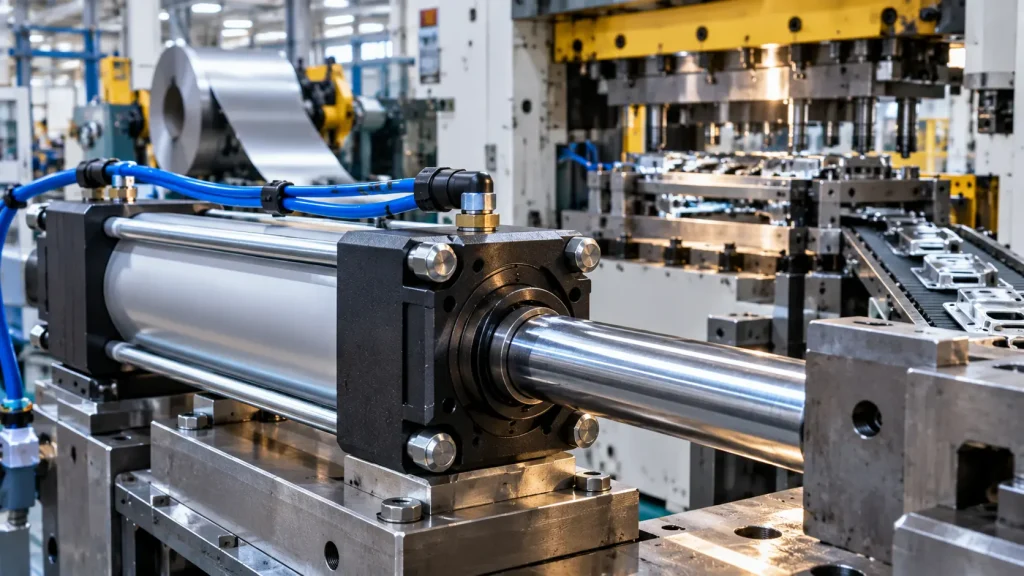
Linear guide rails show up wherever a machine needs to move a load in a precise straight line, often paired with the actuator or motor that actually drives the motion. A rodless cylinder such as the AirTAC Rodless Magnetic Cylinder frequently runs alongside an external guide rail for load support, while a guided cylinder builds a similar rolling-element guide directly into the actuator itself.
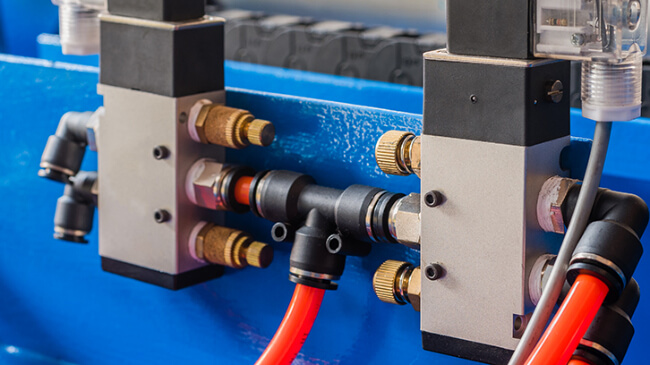
On the electric side, linear rails commonly pair with components from our electrical motion lineup to form a complete motorized axis, while simpler pneumatic slides might combine a rail with an AirTAC Compact Cylinder and a controlling AirTAC Solenoid Valve. For a closer technical comparison of contact stresses and sizing, LinearMotionTips covers the engineering side in more depth. Pneumation’s Airtac lineup covers both ball and roller rail options under our linear guide rails category.
Frequently Asked Questions
Ball guides use point contact and suit general-purpose automation at a lower cost. Roller guides use line contact, giving them higher load capacity and rigidity in the same size, at a higher price and tighter installation tolerance.
No. Roller guides only outperform ball guides where high load capacity or rigidity actually matter. For typical automation loads, a ball guide is usually the more practical and cost-effective option.
It’s used anywhere a machine needs to move a load along a precise, repeatable straight-line path, such as CNC tables, robotic axes, and automated slides in packaging or assembly equipment.
Yes. Their higher rigidity means small misalignments concentrate more force on the rolling elements, which can increase friction and shorten service life if installation isn’t done to a tight tolerance.
Yes. Linear rails are commonly paired with pneumatic cylinders for simpler slides or with electric motors and drives for applications that need programmable positioning along the same axis.
Conclusion
The ball-versus-roller decision is really a question of how much load and rigidity your application actually needs, not which one is objectively better. Ball guides cover the majority of general automation tasks reliably and affordably; roller guides earn their higher cost only when a machine’s precision or load requirements call for it.
If you’re specifying a linear motion axis and aren’t sure which type fits, get in touch and we can help match the guide to your application.