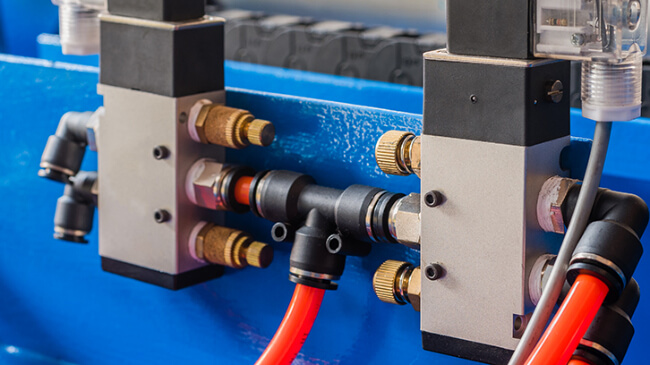
A pneumatic valve’s “way” count tells you how many ports it uses to route air, which in turn determines what it can control. A 2-way valve simply turns a single flow path on or off. A 3-way valve adds an exhaust port and controls a single-acting actuator. A 5-way valve adds a second flow path and a second exhaust, giving it full bidirectional control of a double-acting actuator. The right choice comes down to what’s on the other end of the line.
What Does “Way” Mean in a Pneumatic Valve?
“Way” refers to the number of distinct flow paths, or ports, a valve controls — not simply how many holes are drilled into the body. A port is any connection point where air enters or leaves the valve: supply, outlet, or exhaust.
Valves are usually labeled by both port count and position count, such as “3/2” (three ports, two positions) or “5/2” (five ports, two positions). Port count tells you what the valve connects to; position count tells you how many states it can switch between.
What Is a 2-Way Pneumatic Valve?
A 2-way pneumatic valve has exactly two ports — an inlet and an outlet — and does one job: it lets air through or blocks it. There’s no dedicated exhaust port, because a 2-way valve isn’t built to redirect air anywhere; it’s simply open or shut.
This makes 2-way valves the right fit for basic on/off flow control rather than actuator direction control — shutting off a line, triggering a single air blast, or gating flow to another device downstream. Like other pneumatic valve types, a 2-way valve can be built as normally open or normally closed, depending on which state it should default to when unpowered. Humphrey Manual Valves are a common example of simple, manually actuated 2-way shutoff valves used this way.
What Is a 3-Way Pneumatic Valve?
A 3-way pneumatic valve has three ports — supply, outlet, and exhaust — and is built specifically to run single-acting, spring-return actuators. Air pressurizes the actuator through the outlet port to extend it; when the valve switches, that same outlet connects to the exhaust port instead, venting the actuator so its internal spring can retract it.
Whether a 3-way valve is normally open or normally closed determines its default, unpowered state — normally closed is more common, since it fails to a vented, retracted position if power is lost. Engineers rely on 3-way valves anywhere a cylinder or actuator only needs to move under air pressure in one direction. Humphrey Solenoid Valves and AirTAC Solenoid Valves both include 3-way configurations built for exactly this kind of single-acting control.
What Is a 5-Way Pneumatic Valve?
A 5-way pneumatic valve has five ports — one supply, two outlets, and two separate exhausts — and is built to run double-acting actuators that need air pressure to move in both directions. Each outlet connects to one side of the actuator; when the valve switches position, pressure and exhaust simply swap sides, extending or retracting the actuator on demand rather than relying on a spring.
The separate exhaust ports are what set a 5-way apart from a simpler 4-way design that shares one exhaust for both directions — independent exhaust paths let each stroke vent on its own, which matters for actuation speed. Some 5-way valves also come in a 5/3 configuration, adding a third, center position that can hold the actuator mid-stroke or block all ports, instead of only switching between fully extended and fully retracted. Humphrey Air Piloted Valves are a common choice for 5-way control on larger double-acting cylinders.
2-Way vs. 3-Way vs. 5-Way Pneumatic Valves: Side-by-Side Comparison

| Factor | 2-Way | 3-Way | 5-Way |
|---|---|---|---|
| Ports | 2 (supply, outlet) | 3 (supply, outlet, exhaust) | 5 (supply, 2 outlets, 2 exhausts) |
| Exhaust path | None | One shared exhaust | Two independent exhausts |
| Actuator type | Not actuator-specific | Single-acting, spring-return | Double-acting, air-powered both ways |
| Typical role | On/off flow shutoff | Extend under air, retract by spring | Extend and retract under air pressure |
How Do You Choose the Right Valve Configuration?
The right pneumatic valve configuration depends on what it’s controlling, not on which valve happens to be on hand. If the goal is simply starting or stopping flow to something that isn’t a spring-return actuator, a 2-way valve is usually all that’s needed.
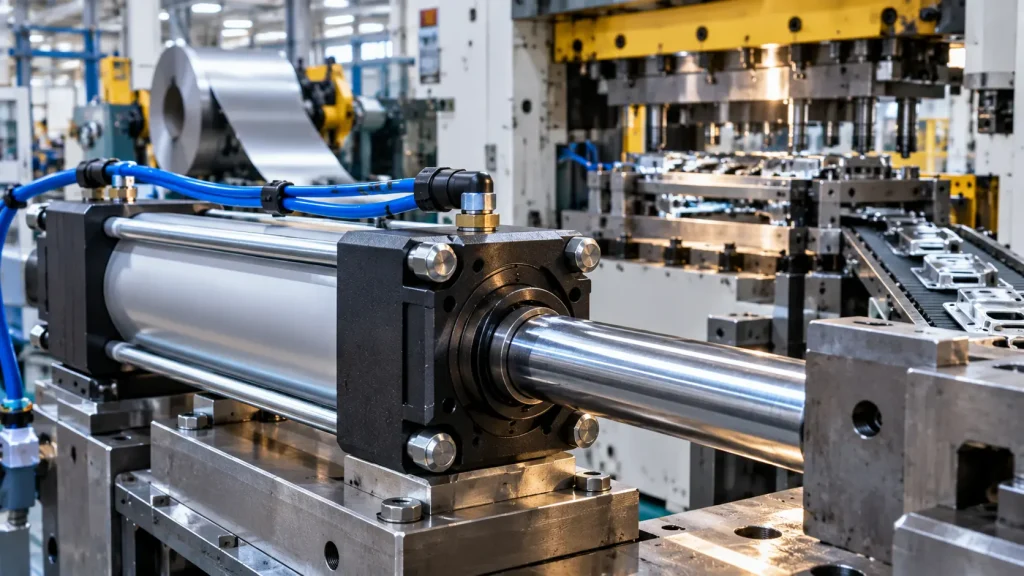
If the application involves a single-acting cylinder that only needs air pressure in one direction, a 3-way valve is the standard match — a 2-way valve leaves no way to vent the actuator for its return stroke. Double-acting cylinders need a 5-way (or at minimum a 4-way) valve instead, since both directions of motion have to be actively pressurized rather than spring-assisted.
Where Are These Pneumatic Directional Control Valves Used?
Pneumatic actuator control across nearly every industry relies on some combination of these three valve types, from simple shutoffs to precise double-acting cylinder control on production equipment. Higher-cycle air flow control valves are common on packaging and assembly lines, while simpler 2-way and 3-way valves show up anywhere a single function just needs to switch on or off.
For finer control than a basic on/off switch, Humphrey ProControl Proportional Valves and Humphrey Proportional Control Stepper Valves modulate flow across a range of positions instead of simply switching states. Pneumation’s full pneumatic valves lineup covers all of these configurations.
Frequently Asked Questions
It refers to the number of distinct flow paths, or ports, the valve controls. A 2-way valve has two ports, a 3-way valve has three, and a 5-way valve has five, each supporting a different level of control.
No. A double-acting cylinder needs air actively pressurizing both sides to extend and retract, which requires a 5-way (or 4-way) valve. A 2-way valve only has one flow path to switch on or off.
A 3-way valve controls one flow path plus an exhaust, suited to single-acting actuators that return by spring. A 5-way valve controls two flow paths with separate exhausts, suited to double-acting actuators that move in both directions under air pressure.
Both configurations exist. Normally closed is more common, since the valve defaults to a vented, de-energized state if power is lost, though normally open versions are available for applications that require the opposite default.
A 5/2 valve switches between two positions only — fully extended or fully retracted. A 5/3 valve adds a third center position, which can hold the actuator in place mid-stroke or block all ports, depending on the design.
Conclusion
The “way” number on a pneumatic valve isn’t a spec to skim past — it tells you directly whether that valve can actually do the job. Match it to the actuator: 2-way for simple on/off flow, 3-way for single-acting cylinders, and 5-way for double-acting cylinders that need full control in both directions.
If you’re specifying valves for a new pneumatic circuit or replacing an existing one, get in touch and we’ll help you match the configuration to your application.